
Architecture
Testflinger Server
The Testflinger server is a Kubernetes (K8s) application deployed using Juju. As a backend, it uses a MongoDB database that stores all data related to Testflinger, including job definitions, job results, agent information, and more.
The preferred way to deploy MongoDB is to use the MongoDB machine charm, which deploys a MongoDB instance on a virtual machine (VM). This can improve performance and reduce resource complexity compared to deploying MongoDB as a K8s application.
The following diagram illustrates the architecture of the Testflinger server deployment:
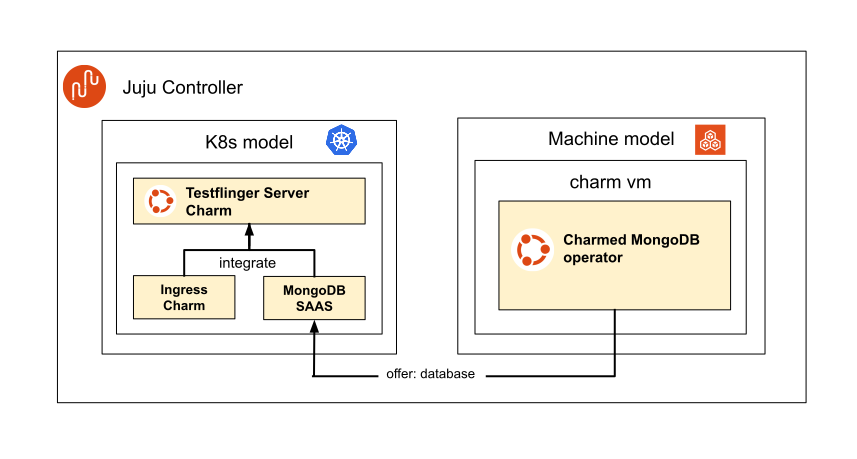
In the above diagram, there is a single Juju Controller that manages both the K8s and machine Juju models. In the machine model, only the MongoDB charm is deployed, while in the K8s model, the Testflinger server charm and the ingress charm are deployed.
To allow the Testflinger server to communicate with the MongoDB database we
need to set up a cross-model relation. This is achieved by offering the database
endpoint from the machine model and consuming it in the K8s model as a SAAS
application. The Testflinger server charm is then related with both
the ingress charm and the MongoDB SAAS via Juju Integration
to enable API access and database connectivity. For a more detailed guide
on how the cross-model relation is set up, please refer to the
Juju How to Manage offers guide.